A NEW LANDMARK FOR THE SANTA FE RAILYARD
Planetock at the Railyard
The covered Railyard platform becomes an outdoor planetarium. Free, always open. Turning the path that once carried people and goods through Santa Fe into an exploration of the cosmos.
Railyard Park + Plaza – Santa Fe, NM | October 2026 - June 2027
John Williams – planetock.com | terrazoom.com
Railyard Park + Plaza
Railyard Plaza covered platform
October 2026 - June 2027
Nine months, open every day
Free, Always
No ticket, no app required to look
2-3 Star Parties
Free public events. Come explore the night sky with us.
About Planetock
Planetock is a clock that shows you the sky. Nine planet hands point to exactly where each planet hangs above you right now; even in broad daylight, when the sky looks empty and isn't.
I built it because I wanted an answer I already had; what's actually up there, to be one glance away for anyone with a phone. The face shifts through the day the way the real sky does: deep blue through the afternoon, warming at the rim as sunset comes on, deepening into violet and indigo as the stars and the Milky Way come out. The sky belongs to everyone. This is one small way of handing it back.
The installation asks two questions. What is above you right now? And what have we lost?
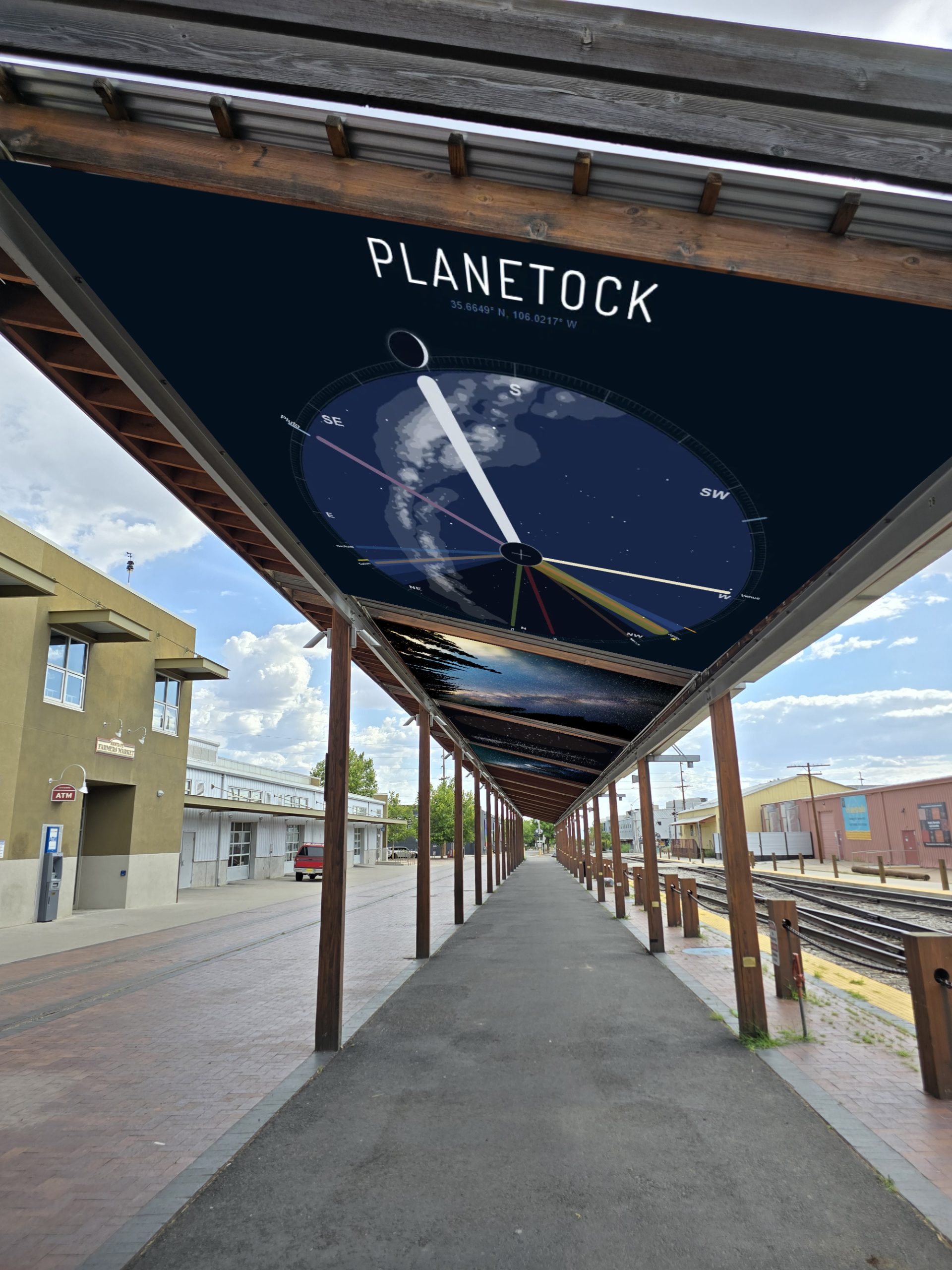
Walking the covered Railyard platform, visitors pass large-format panels suspended along the ceiling. The journey begins with a stark comparison: the night sky above New York City, barely a dozen stars in brown light-polluted soup, beside the night sky above Santa Fe, the Milky Way arching in full glory. Then the artist's own astrophotography; the galactic core rising over dark ridgelines, a crescent moon against a river of stars.
Then the question: what about right now, in broad daylight? The daytime sky looks empty.
It isn't.
At the platform's end, the installation answers. A projection against a reflective screen sits between the ceiling beams shows Planetock. Simply, a circular dial in which every planet is a hand pointing in the direction to where it hangs above Santa Fe at this moment. Nine planet hands. The Sun. The Moon showing its current phase. The face shifts through the day; deep blue in the afternoon, warming at the rim as sunset approaches, deepening through violet and indigo into astronomical night as stars and the Milky Way emerge. Visitors look up and see the solar system, alive and turning above them. In real time. Planetock is a clock programmed in simple HTML and Javascript. It is self contained running on a tiny computer attached to a projector. It doesn't need the internet. Just power and space.
Additionally, two decorative telescopes stand nearby. The Sky Clock points south, its eyepiece showing the Planetock dial. Intimate, one person at a time. The Sky Finder swings freely: an orientation sensor drives a live star chart in the eyepiece showing exactly that patch of sky. Aim at empty blue and Venus appears — confirmed present, invisible to the naked eye. That gap between the empty sky and the confirmed presence is where wonder lives.
Two QR codes, with two free takeaways, complete the installation. Planetock (planetock.com), the live sky clock, free on any phone. Skyglow (terrazoom.com/dev/skyglow/) shows the night sky from anywhere on Earth, calibrated to real light-pollution data. Type in New York: a handful of stars show in brown soup. Compare to Santa Fe: the Milky Way returns. Press "See the Sky of the Ancients" and see what Puebloan astronomers saw from this same ground.
The shaded Railyard platform, beside the southwest-trending tracks, is the only place in Santa Fe where this could exist. The path that carried people and goods for a century now carries visitors through the cosmos. Related events include free public star parties and a curated exhibition of local astrophotography hanging between the columns.
Experience an entire day of Planetock
Watch the timelapse video capturing the movement of the planets, Moon and Sun across the sky.
About the artist

Creative Technologist | Author | Astrophotographer | Storyteller
Santa Fe, NM
John Williams connects audiences with the awe and wonder of nature, merging art and science through photography, storytelling, and technology. An award-winning author, science communicator and web developer, he has spent his career at the intersection of science and human experience. His passion is the night sky; its scale, its beauty, its constant presence in our stories, and the way it roots us in time and place.
I can't imagine a day without creating something. Through writing, coding, and photography, I have a passion for storytelling; especially sharing the excitement of space and astronomy. Everything I make is rooted in three things: a desire to share an answer I’ve found, because someone else might need it too. A desire to share something beautiful, because beauty costs nothing extra to give. And a love of nature and the sky that I carry forward from the people who first brought me outside to look up. They are not here anymore. But every time a child points a telescope at empty blue and finds Venus — I get to bring them along anyway. The sky belongs to everyone. So does this.
—John Williams
Explore the Universe with Planetock
The daytime sky looks empty. It isn't.
Right now, at this moment, Venus is hanging above the southwestern horizon — brilliant, close, completely invisible in the blue glare of the afternoon. Jupiter is there too. Saturn. The Moon is often present in broad daylight, a ghost disc no one thinks to look for. The entire solar system is above us, every hour of every day, hiding in plain sight.
Planetock makes the invisible visible.
The installation brings together three interconnected experiences — a large communal screen, and two telescopes — each offering a different relationship with the same sky.
The Large Screen
A large outdoor display shows the Planetock sky clock running live — a circular dial in which every planet is a hand, pointing to exactly where it hangs in the sky above Santa Fe at this moment. Eleven hands show each planet, the Sun and Moon (with the Moon hand showing its current phase.) At night, the Milky Way fades into view showing its true position. The face also shifts depending on the time of day; deep blue in the afternoon, with the rim warming to gold and orange at the rim as sunset approaches. Then deepening through violet and indigo into the blue-black of night as stars emerge across the face. This is the communal experience visible from across the park, immediately readable, a portrait of the sky that ten people can stand before and explore together.
Telescope One — The Sky Clock
For a more intimate experience, a decorative telescope mounted on a fixed alt-azimuth base, points south in the same orientation as the Planetock screen. Looking through the eyepiece, a visitor sees the complete Planetock dial on a circular display: the same planet hands, the same Milky Way, the same breathing sky face as the large screen, but intimate and personal. One person at a time. The experience of looking through a telescope at the solar system.
Telescope Two — The Sky Finder
Another identical telescope with a free-swinging mount offers a chance to see what can’t be seen during the daytime As a visitor points it at any part of the sky, an orientation sensor tracks the telescope's direction and elevation in real time. The circular eyepiece display responds showing a live star chart of exactly that patch of sky, powered by open-source celestial mapping software. Aim it at empty blue sky above the Jemez Mountains and the chart shows Venus, right there, confirmed, invisible to the naked eye but present and accounted for. Swing it across the southern sky and watch the planets appear and disappear as the telescope passes through their positions. Point it straight up at midnight and see the name of the constellations.
This is the experience no flat screen can offer. A flat screen tells you Venus is in the southwest. The telescope makes you aim at nothing and believe something is there. That gap — between the empty sky and the confirmed presence — is where wonder lives.
The Phone
A QR code panel at the base of the installation links to planetock.com — the same live sky clock, free, on any phone that visitors can carry home and use anytime. The installation in the Railyard becomes the beginning of an ongoing relationship with their own sky, wherever they are.
The installation works at two in the afternoon on a Tuesday in October, when families are moving through the Railyard after the farmers market. It works in the blue hour after sunset. It works on a cold January morning when the air is sharp and the sky is deep. It requires no darkness. It requires no special knowledge and is simple in its design.
The sky is always there. Planetock is an invitation to notice.